Property Investment Mistakes: 10 Costly Errors Every Investor Should Avoid
2026 • Real Estate Lead Generation
2026 • Real Estate Lead Generation

Whitestone Global
Business Insights
Thinking about investing in property? Don't let an attractive property, a convincing salesperson, or a promising location make the decision for you.
Real estate can be one of the most valuable long-term investments, but buying the wrong property can lock your money into an underperforming asset for years.
Whether you are planning property investment in Pune, buying your first residential property, looking for an investment property, or exploring real estate opportunities in India, understanding the common property investment mistakes can help you make a more informed decision.
The biggest mistake is not choosing the wrong property.
It is making a property investment decision without looking at the complete picture.
Property investment involves much more than comparing the purchase price of two properties. You need to consider:
A property may look affordable today but become expensive after adding registration charges, maintenance, loan interest, furnishing, taxes and other costs. That is why successful investors don't simply ask "How much does this property cost?" — they ask "What am I actually getting for my money, and what could this property be worth in the future?"
A low price does not automatically mean a good investment. Sometimes, properties are priced lower because of limited connectivity, weak demand, poor infrastructure, oversupply, legal complications or low resale interest. Before considering an inexpensive property, evaluate the complete investment potential. Ask:
Affordable does not always mean profitable.
The goal should be to identify value, not simply a low purchase price.
One of the most important rules of real estate is: Location matters. A beautifully designed property in a weak location may perform worse than an average property in a high-demand location. When researching a location, look beyond today's surroundings. Consider:
For investors considering property investment in Pune, for example, comparing different micro-markets can be more useful than simply comparing builders or property prices. A location with strong employment connectivity and growing infrastructure may have better long-term demand than a cheaper but isolated location.
Many investors make the mistake of assuming: "The property will increase in value, so it must be a good investment." But appreciation alone should not be the only consideration. A better approach is to evaluate the property's overall potential. For example:
Purchase Price → Rental Potential → Annual Expenses → Loan Cost → Expected Appreciation → Resale Demand
A property with slightly lower expected appreciation but strong rental demand and easier resale may be more practical than an expensive property that depends entirely on future appreciation. Look at the complete investment equation, not just one number.
The advertised property price is rarely the final amount you will spend. Depending on the transaction, your overall investment may include:
This is one of the most common property buying mistakes made by first-time investors. Before committing, calculate the total acquisition cost and determine whether the investment still makes financial sense.
Real estate investment can be strongly influenced by emotions. You may hear:
"Prices are going up." · "This area is going to become the next big location." · "Only a few units are left." · "Buy now or you will miss the opportunity."
These statements can create urgency, but urgency should never replace due diligence. A property should fit your investment objective, budget and risk tolerance. Don't invest simply because friends are investing there, a relative recommended it, a social media influencer promoted it, a salesperson created urgency, or everyone is talking about the location.
Do your own research before committing your capital.
If your objective is rental income, don't assume that every residential property will generate strong rent. Rental demand depends on the people who actually live and work around the property. Before purchasing a rental property, research:
For example, a compact apartment near an employment hub may attract more tenants than a larger property located far away from workplaces and transportation. If rental income is important to your strategy, rental demand should be evaluated before buying — not after.
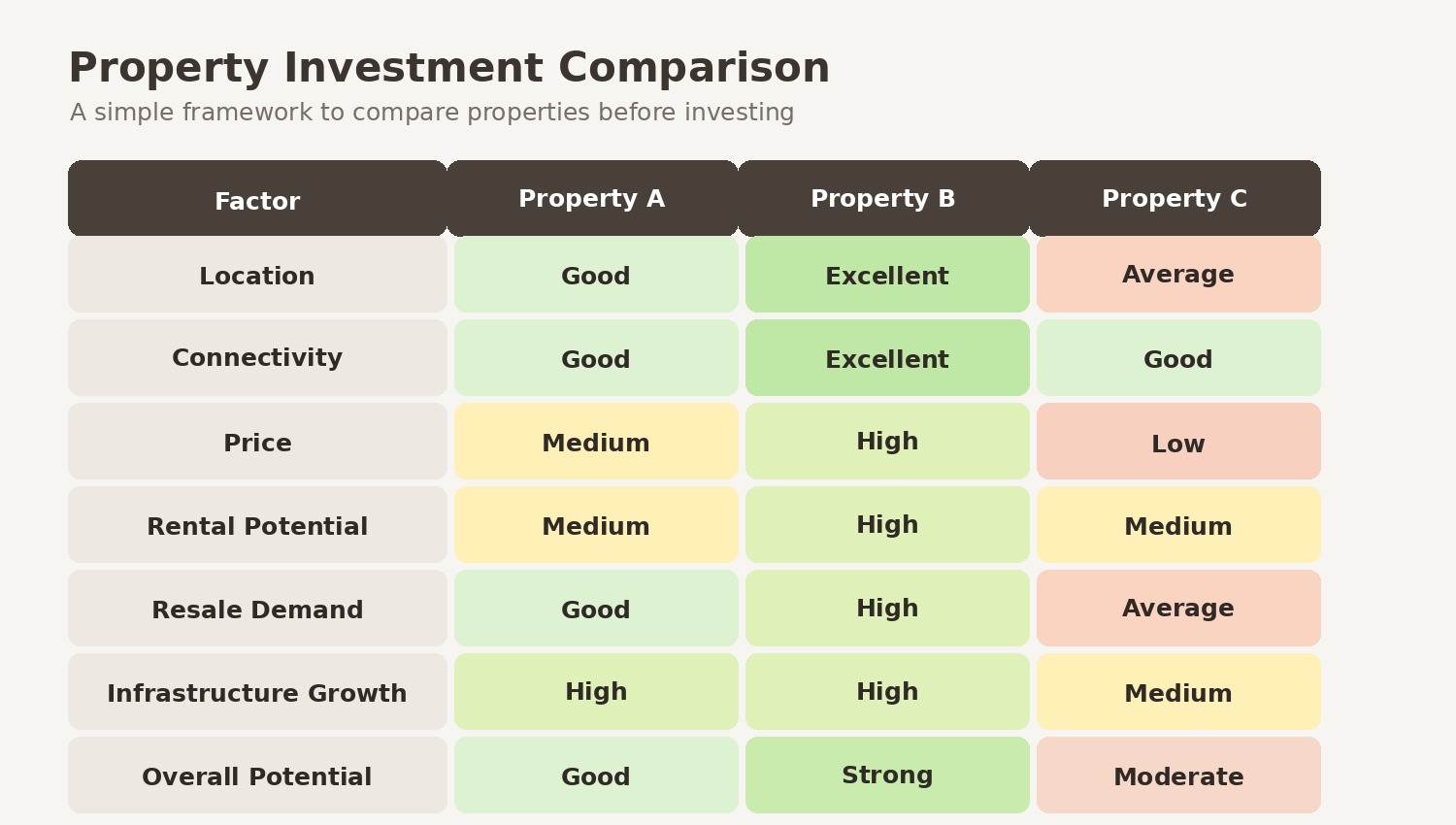
Another common real estate investment mistake is falling in love with the first property you visit. The first property may look excellent. But how does it compare with similar properties in the same locality, competing projects, resale properties, other developers, upcoming projects, rental yields, and infrastructure & connectivity?
A proper comparison can reveal differences that are difficult to notice during a single property visit:
Same Budget, Different Value — Why Comparing Matters
Overall investment value score (location, rental demand, appreciation, resale demand & total cost combined, out of 100). The cheapest option isn't always the best — and neither is the most expensive. The strongest opportunity is often the one with the best value.
The objective isn't to find the cheapest property. It is to identify the property that offers the strongest overall investment proposition for your objective.
The developer behind a project matters. Before investing, research previous projects, delivery history, construction quality, customer feedback, project approvals, legal history where relevant, maintenance standards, and reputation in the market. Don't evaluate a developer only through advertisements — look at their actual track record. A visually impressive brochure can attract attention, but an investor should also investigate what the developer has delivered in reality.
One of the most serious property investment mistakes is focusing entirely on price and location while neglecting documentation. Before purchasing, investors should verify the relevant legal and property documents and, where appropriate, obtain professional legal advice. Depending on the property and transaction, checks may include:
Never rely solely on verbal assurances.
If something is unclear, get it reviewed by a qualified professional before proceeding.
Many investors think about only one side of the investment: "How will I buy this property?" Experienced investors also ask: "How will I exit?" Your exit strategy could involve selling after appreciation, holding for rental income, selling after infrastructure development, upgrading to another property, or long-term wealth creation. Before investing, think about who your potential buyer will be in the future. A property with strong future demand can potentially be easier to sell than a property purchased purely because it was cheap.
Property is emotional. It is easy to imagine your family living in a beautiful apartment, visualize the future lifestyle, or become excited about a promising location. But investment decisions should be based on data, research and financial logic. Before making a decision, separate emotion ("I really like this property.") from investment logic ("This property fits my budget, has strong demand, reasonable acquisition costs, good connectivity, suitable rental potential and a realistic exit opportunity."). You can like a property — but make sure the numbers like it too.
A disciplined property investment process can reduce unnecessary risk.
Pune continues to attract residential and commercial interest because of its employment ecosystem, educational institutions, infrastructure development and expanding urban areas. However, saying "Pune is a good real estate market" is not enough to make an investment decision. Different parts of Pune can have completely different property prices, rental demand, buyer profiles, infrastructure, employment connectivity, development potential and resale demand.
Therefore, investors should evaluate the micro-market, not just the city. Instead of asking "Is Pune a good place to invest?", ask "Which location, property type and price point in Pune best match my investment objective?" — a much more useful question.
Before making your final decision, ask yourself:
If several answers are "No," it may be worth doing more research before investing.
Real estate can be a powerful wealth-building asset, but not every property is a good investment. The right investment is not necessarily the most expensive property, the newest project or the one with the most attractive advertisement. It is the property that makes sense when you look at the location, price, demand, infrastructure, rental potential, developer, documentation, financing and exit strategy together.
The smartest investors don't rush. They research. They compare. They calculate. Then they decide.
Looking for the Right Property Investment Opportunity?
At Whitestone Global, we help connect investors and property seekers with carefully evaluated real estate opportunities and support them in understanding market options before taking the next step. Invest because the opportunity makes sense — make your next property decision with research, not guesswork.
Explore Real Estate Opportunities → Book a Property Consultation